
What Age Should My Child See an Orthodontist?
Reviewed by Dr. Ai Huang, board-certified orthodontist at AiCare Orthodontics.
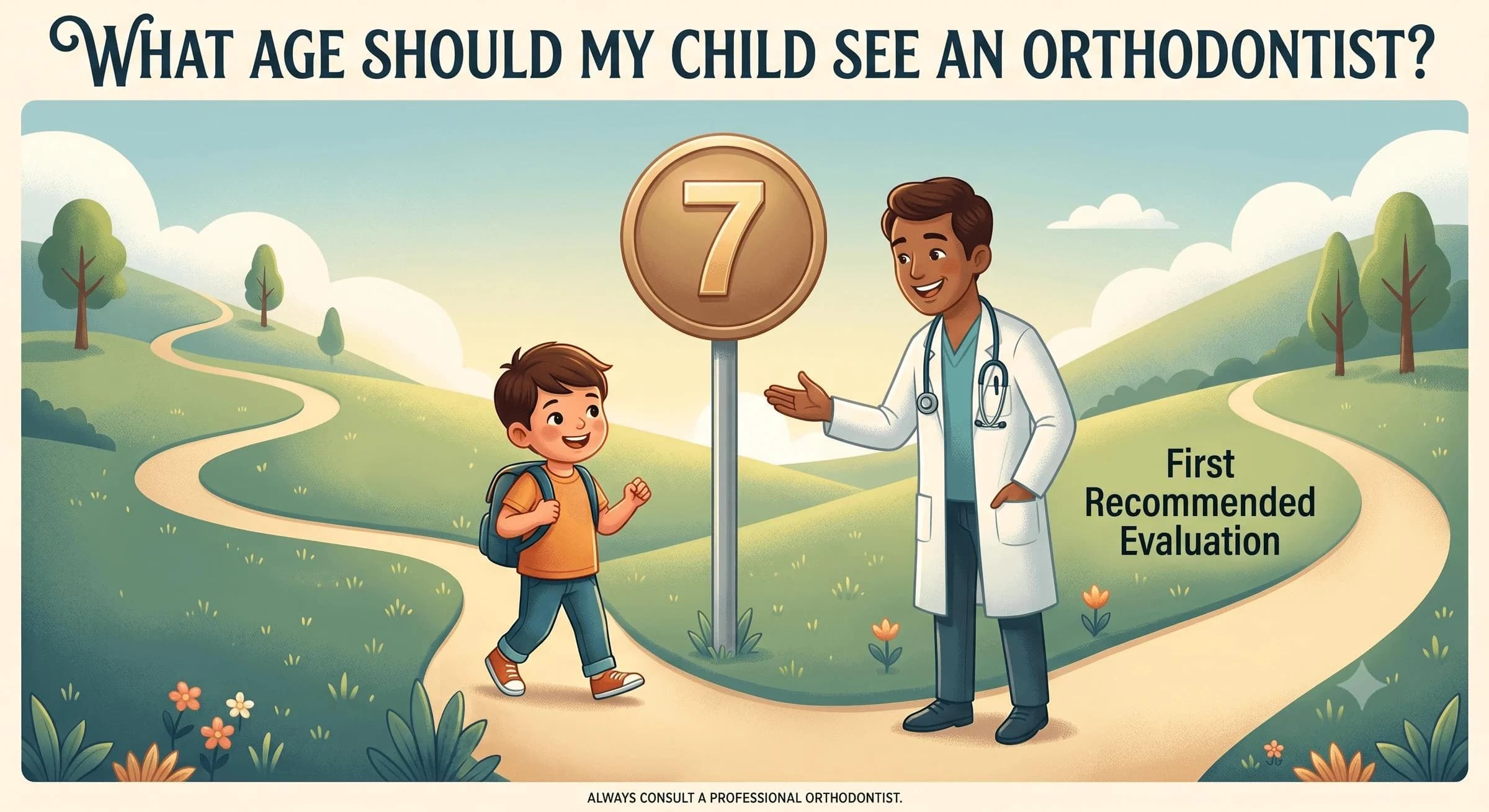
If you're a parent, you've probably wondered — maybe while watching your child's grin change tooth by tooth — when is the right time to see an orthodontist? Should you wait until all the baby teeth are gone? Until the dentist says something? Until the teen years?
The American Association of Orthodontists recommends a first orthodontic check-up by age 7. If you notice a concern earlier, ask an orthodontist about an earlier evaluation.
An early check-up helps an orthodontist assess developing teeth and jaws. It does not mean every child needs immediate treatment. The timing and type of any treatment depend on the individual findings.
Here's what every parent should know.
Why Age 7? What's Special About It?
By around age 7, your child has a mix of baby teeth and permanent teeth, and the first permanent molars have usually come in — establishing the back bite. That combination gives an orthodontist a clear early picture of how the jaws and teeth are developing.
At this age, Dr. Huang can already tell whether there's:
Enough room for the incoming permanent teeth, or crowding on the way
A developing crossbite, underbite, or deep overbite
A jaw that's growing unevenly or too narrow
Habits like thumb-sucking or tongue-thrusting that are reshaping the bite
Teeth that are erupting out of position — or at risk of becoming impacted (stuck)
Just as importantly, a child's jaw is still growing at 7. Some problems that are simple to guide while the growth plates are active become far more difficult — sometimes requiring extractions or even surgery — if they're left until the jaw has finished growing in the teen years.
Does an Early Visit Mean Early Braces?
No — and this is the biggest misconception we hear from Fountain Valley parents at AiCare Orthodontics.
Most first visits end with no treatment at all. After an evaluation, one of three things typically happens:
All clear. Everything is developing normally, and no follow-up is needed beyond routine dental care.
Watch and wait. Dr. Huang spots something worth monitoring and schedules periodic growth check visits — usually free of charge — so treatment can begin at exactly the right moment, if it's ever needed.
Early (Phase 1) treatment. A developing problem would be significantly harder to fix later, so a limited course of early treatment is recommended now.
Think of the age-7 visit as an inexpensive insurance policy: most of the time it buys you peace of mind, and occasionally it catches something at the moment it's most fixable.
What Is Phase 1 (Early) Treatment — and When Is It Worth It?
Phase 1, also called interceptive treatment, is limited treatment done while a child still has baby teeth, typically between ages 7 and 10. It doesn't replace braces or aligners later — it makes that later treatment shorter, simpler, or in some cases unnecessary.
Common examples Dr. Huang treats at our Fountain Valley office:
Palatal expansion to widen a narrow upper jaw. Because the growth suture in the palate is still open in young children, an expander can create room for crowded teeth—often reducing the need for extractions or preventing impacted teeth down the road. Depending on your child's needs, Dr. Huang may recommend a traditional expander or the Invisalign® Palatal Expander, a removable, 3D-printed option designed for growing children.
Underbite correction with facemask (reverse-pull headgear) therapy. When started at the right age, a facemask is often used together with a palatal expander to gently encourage forward growth of the upper jaw while a child is still growing, helping improve the bite and potentially reducing the need for more invasive treatment later.
Crossbite correction, so the jaw stops shifting to one side as it grows (uncorrected, this can cause the jaw to grow asymmetrically).
Space management—holding room open for permanent teeth after early loss of a baby tooth, or strategically removing a stubborn baby tooth so the permanent one can erupt in a better position.
Habit appliances to help kids stop thumb-sucking or tongue-thrusting before those habits reshape the bite
Phase 2 — full braces or Invisalign Teen — then happens (if needed) once most permanent teeth are in, usually around ages 11–13.
Signs Your Child Should See an Orthodontist Sooner
Age 7 is the standard recommendation, but book an evaluation at any age if you notice:
Early or late loss of baby teeth
Difficulty chewing or biting
Mouth breathing or snoring
Thumb-sucking continuing past age 5
Crowded, overlapping, or noticeably misplaced teeth
A jaw that shifts to one side, or top and bottom teeth that don't meet
Front teeth that protrude significantly (these are also at higher risk of injury)
Speech difficulties
And if your child is already past 7 — don't worry, it's not too late. Dr. Huang treats patients of every age at AiCare Orthodontics, from young children to adults. The best time for an evaluation is simply as soon as you have a concern.
What Happens at the First Visit?
A first orthodontic visit at AiCare Orthodontics in Fountain Valley is easy and pressure-free:
A gentle exam of your child's teeth, bite, and jaw development
Digital imaging as needed to see incoming permanent teeth
A clear explanation from Dr. Huang about what's developing normally and what (if anything) is worth watching
An honest recommendation — including "no treatment needed" when that's the truth
There's no obligation and nothing scary — most kids leave thinking it was fun.
Quick FAQ for Parents
What age should a child first see an orthodontist? By age 7, according to the American Association of Orthodontists — even if their teeth look straight.
Does my child need a referral from our dentist? No. You can schedule an orthodontic evaluation directly, with or without a referral.
Do most kids need Phase 1 treatment? No. Most children evaluated at age 7 need either nothing or simple monitoring. Early treatment is recommended only when waiting would make the problem harder to fix.
What age do kids usually get braces? Most children who need full braces or aligners start between ages 11 and 13, once most permanent teeth have erupted.
Is an early evaluation expensive? At AiCare Orthodontics, the initial consultation is designed to be accessible for Fountain Valley families — contact us for current details. Growth-monitoring visits for young patients are typically complimentary.
Schedule Your Child's First Orthodontic Visit in Fountain Valley
An age-7 checkup takes less than an hour, and most of the time the news is simply: "Everything looks great — see you in a year." When it's not, you'll be glad you caught it early.
Dr. Ai Huang is a board-certified orthodontist at AiCare Orthodontics, serving families in Fountain Valley, Irvine, Huntington Beach, and across Orange County.
Schedule your child's complimentary evaluation at AiCare Orthodontics today.